Designing a Custom 3D Printed Ankle Cage Implant
Designing a Custom 3D Printed Ankle Cage Implant
Designing a Custom 3D Printed Ankle Cage Implant

Manufacturing a Transparent Kidney Phantom
Background and Motivation:
Laser Lithotripsy is a relatively new minimally invasive procedure for the ablation of kidney stones. An optical fiber is inserted through an ureteroscope into the kidney or ureter and fired at the kidney stone with the intention of fragmenting or dusting the stone until it can be passed through the urinary system or removed with a basket. Currently, the mechanisms driving the fragmentation and dusting of kidney stones are still not well understood.
The Zhong Lab at Duke University aims to investigate the influence of cavitation and bubble dynamics on kidney stone fragmentation, and required an anatomically accurate, transparent kidney phantom for use in high speed imaging experiments.

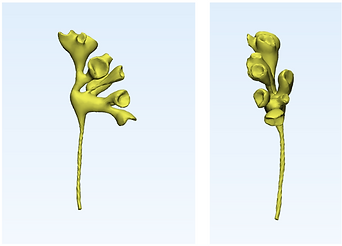
We began with a CT scan of a representative patient at Duke Hospital. The kidneys were segmented out from the rest of the patient's anatomy and converted into a 3D model using Materialize Mimics and 3-Matic. The internal collecting system was separated from the external structure of the kidney and simplified for ease of model fabrication.


The phantom was designed to be manufactured in two halves. To produce a kidney phantom, Humimics medical gel would be melted and poured into the molds shown below. After the gel cured, the 3D printed internal mold would then be removed to leave an impression of the kidney's internal collecting system on each half of the phantom.
Several design requirements included the need for easy insertion and removal of artificial kidney stones for experimentation, irrigation ports, an optically transparent window to allow for clear, high resolution video. Additionally, the phantom material must have mechanical and acoustic properties that are similar to that of real kidney tissue.


The two halves of the kidney phantom would then be assembled and held together using an external frame.
The phantom incorporates several important anatomical regions of the kidney's internal geometry: the ureter, ureteropelvic junction, and upper, lower, and middle calyx poles. This allows for simulation of real clinical procedure during experimentation.
Throughout this processes, we continuously iterated on our design and manufacturing methods to increase model transparency.
Now, the process of producing a kidney phantom has been simplified into 5 steps:
-
Melt Humimics Medical Gel at 165 °F
-
Coat external and internal molds in non-stick spray
-
Pour Melted Medical Gel into molds and keep temperature at 165 °F to allow air bubbles to clear
-
Let phantom cool for 8-12 hours
-
Remove finished phantom from mold and assemble using external frame.
The phantom model has been used in several preliminary experiments where stones are treated with a given number of high energy pulses (0.8-1.0J) and stone fragmentation behavior is observed. We are now in the process of collecting data for publication.


The high level of clarity in the phantom model allows for high resolution images of artificial kidney stones and bubble dynamics during cavitation experimentation.

Team picture outside of the OR! We were able to observe a few Laser Lithotripsy procedures to further advance our understanding of the treatment.